
Traveling is not just about the places we visit; it’s about the connections we make. By understanding nonverbal cues, we can unlock a deeper level of communication and enrich our travel experiences. To truly master nonverbal communication for effective travel experiences, it’s essential to pay attention to the nuances of body language and gestures.
Understanding Nonverbal Communication in Travel
When I first started traveling, I quickly learned that words often weren’t enough. I remember standing in a bustling market in Morocco, surrounded by vibrant colors and enticing scents. I wanted to buy some spices, but my limited Arabic made the task tricky. That’s when I realized how powerful nonverbal communication could be. The gestures, expressions, and general body language of the locals were vital in bridging the gap between us. That’s when I became fascinated with nonverbal cues and their role in travel.
What are Nonverbal Cues?
Nonverbal cues are the subtle signals and messages we send without using words. They include body language, facial expressions, gestures, posture, and even the use of space. For me, it’s almost like a dance; each person brings their own unique steps to the performance. When we travel, being aware of these cues can transform our interactions. They can tell us when someone is friendly or when we might be overstaying our welcome. I often find myself picking up on these signals instinctively, sometimes even before I realize what’s happening.
The Importance of Nonverbal Communication in Different Cultures
Every culture has its own set of nonverbal cues. I remember my first trip to Japan, where bowing is a common greeting. At first, I felt a bit awkward, unsure of how low to bow or when to smile. But as I observed others, I learned that nonverbal communication differs greatly depending on where you are. In some cultures, maintaining eye contact is a sign of confidence, while in others, it may be seen as disrespectful. The more I traveled, the more I realized that understanding these differences could help me connect with people on a much deeper level.
Recognizing these nuances can lead to smoother interactions and prevent misunderstandings. For instance, during a trip to Italy, I found that hand gestures were almost a language of their own. A simple wave could mean “hello,” while a pointed finger could indicate impatience. I started mimicking some of these gestures, and it helped me build rapport with the locals, who appreciated my efforts to communicate in their cultural context.
Key Nonverbal Cues to Recognize While Traveling
Body Language and Gestures
Body language can convey a wealth of information. When I was backpacking through South America, I learned that a relaxed posture often indicated friendliness, while crossed arms could suggest defensiveness. I found that observing how people interacted with each other was a window into their cultural norms. In many places, gestures can be as expressive as spoken language. For example, in some parts of Greece, a thumbs-up is a positive gesture, while in other cultures, it can have an entirely different meaning. I always try to stay aware of my own body language, too; it communicates my openness and willingness to engage with others.
Facial Expressions and Emotional Signals
Facial expressions are perhaps the most universal form of nonverbal communication. A smile can go a long way. I remember standing in a remote village in Thailand, where language barriers were strong. However, when I smiled and nodded, I noticed the locals responded in kind. Their faces lit up, and suddenly, we were communicating feelings rather than words. The ability to read someone’s facial expressions can also offer insights into their emotions. Are they happy to see you? Nervous? Engaged? Throughout my travels, I’ve learned to pay close attention to these signals; they can guide how I respond in a conversation.
Spatial Awareness: Proxemics in Different Cultures
Proxemics, or the use of personal space, varies widely around the world. I’ve experienced this firsthand. In some cultures, close proximity during conversation is a sign of warmth and friendliness, while in others, it might feel invasive. I remember being in a crowded café in Spain, where people sat elbow to elbow, laughing and chatting. Yet, when I traveled to the UK, I noticed people tended to stand a bit farther apart during conversations. Understanding these spatial norms can help you avoid awkwardness and discomfort when interacting with locals.
Eye Contact: Cultural Differences and Significance
Eye contact can be a tricky area to navigate. In some cultures, maintaining eye contact is a sign of confidence and honesty. However, in others, it may be viewed as disrespectful or aggressive. I experienced this during a visit to some Indigenous communities in Canada, where prolonged eye contact was often avoided. It taught me to be more observant and adaptive. I started to notice how people would glance at each other, then look away, creating a flow of interaction that felt respectful and genuine. Adapting to these norms can help foster trust and understanding.
How to Interpret Nonverbal Cues in Various Travel Scenarios
Interacting with Locals: Building Rapport
When I travel, one of my favorite parts is engaging with locals. It’s those genuine interactions that often lead to the most memorable experiences. I remember hanging out in a small café in Portugal, where the barista seemed busy but friendly. By observing her body language, I noticed she often smiled and leaned slightly toward customers while taking their orders. I decided to mimic her posture a bit, and it felt like we were sharing a moment of connection. This nonverbal cue of leaning in signified my interest, and I felt it encouraged her to open up more. I believe that by being mindful of these signals, we can create a warm atmosphere that invites conversation and friendship.
Reading Nonverbal Signals in Markets and Public Spaces
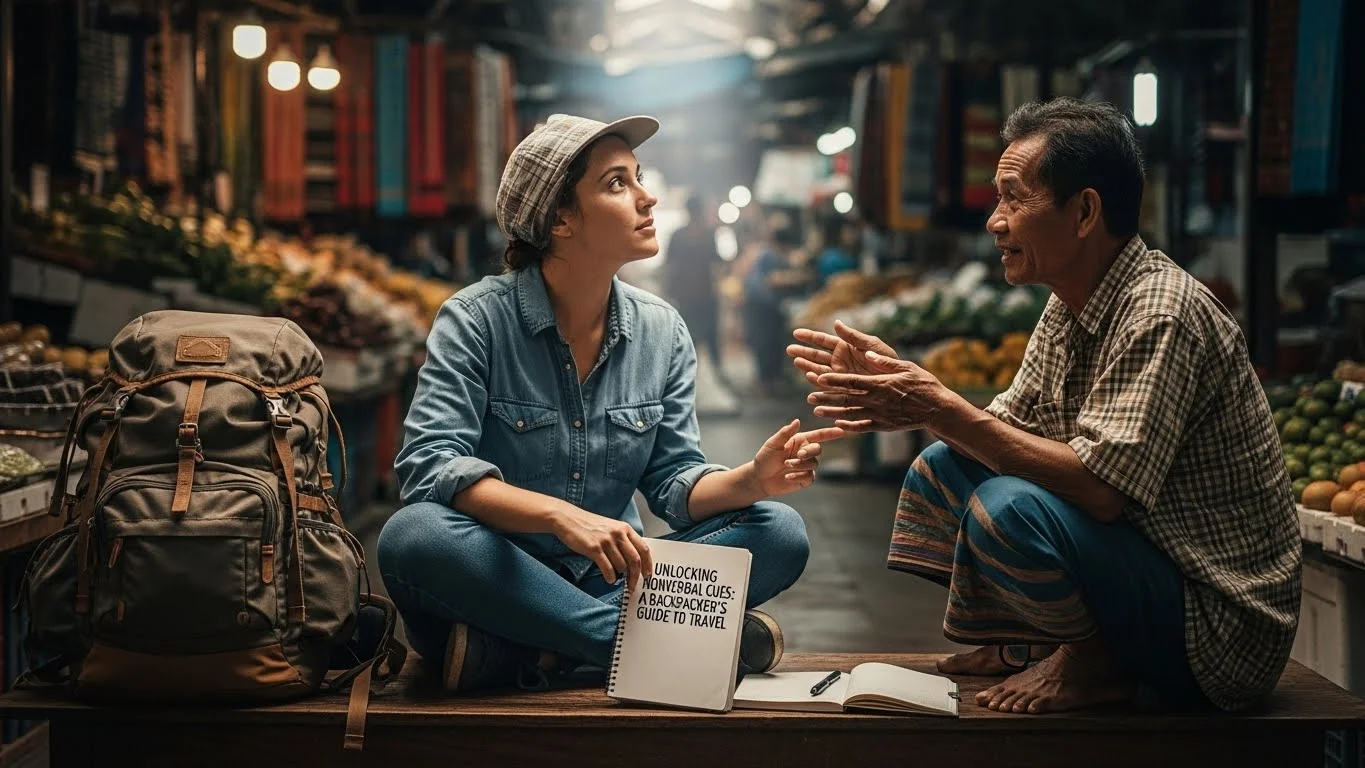
Markets are vibrant hubs where nonverbal communication shines. During my time in a bustling market in India, I noticed how vendors used gestures to attract customers. They would wave their hands, point to their goods, and use facial expressions to convey excitement. I tried to engage in the same way, using my own gestures to show interest in their products. I found that smiling and giving a thumbs-up could create instant connections. When I hesitated or looked confused, the vendors would often step back, sensing my uncertainty. This taught me the importance of being aware of how my own signals were received. In crowded spaces, I learned to read the energy of the environment; it helped me decide when to approach someone and when to step back.
Understanding Nonverbal Communication in Formal Settings
Formal settings, like meetings or ceremonies, often have their own unspoken rules. I had a memorable experience attending a traditional wedding in Greece, where I noticed how body language was crucial to the ceremony. The family members stood close together, displaying a sense of unity. I felt a bit out of place at first, standing further away. However, I observed how the closer I got, the more welcomed I felt. When I took a seat beside a local, I noticed how they leaned in during conversations, which encouraged me to do the same. It was fascinating to see how nonverbal cues can dictate the flow of interactions, especially in formal or emotional settings. I learned that adapting to the environment was key to connecting with others, making me feel part of the celebration.
Nonverbal Etiquette: Dos and Don’ts Around the World
Handshake Variations Across Cultures
Handshakes seem like a universal gesture, but I quickly discovered that they can vary significantly from one culture to another. While traveling in the Middle East, I was surprised to learn that a light touch can be more appropriate than a firm handshake, especially with women. I remember being a bit hesitant at first, unsure how to approach the situation. But I observed how the locals greeted each other—gentle handshakes accompanied by smiles. This taught me the importance of adapting my greeting style. In contrast, I found that in places like the US, a firm handshake is often associated with confidence. I’ve learned to pay close attention to these cultural nuances, as they can set the tone for the entire interaction.
Personal Space Norms in Different Countries
Understanding personal space can be tricky, especially when you’re moving through different cultures. I experienced this firsthand during my travels in Brazil, where people seemed to stand much closer than I was used to. At first, I felt a little uncomfortable, but I soon realized that this closeness was a sign of warmth and friendliness. In contrast, during my time in Scandinavia, I noticed that people preferred a bit more space during conversations. Adjusting my distance based on the cultural context made my interactions much smoother. I’ve found that respecting these personal space norms not only avoids discomfort but also fosters a sense of respect and understanding.
Gestures to Avoid: What Not to Do
As travelers, we often use gestures to express ourselves, but some can carry unintended meanings in different cultures. I learned this lesson the hard way when I was in the Philippines, where the “peace” sign can be seen as offensive if the palm faces inward. I remember taking a casual picture with friends, flashing that sign, and immediately noticing the uncomfortable looks around me. I quickly learned to be cautious about which gestures I used. It’s essential to research and understand the meanings behind common gestures in the countries we visit. This awareness not only helps avoid misunderstandings but also shows respect for local customs.
Practical Tips for Backpackers
How to Improve Your Nonverbal Communication Skills
Improving your nonverbal communication skills can be incredibly rewarding, especially when you’re traveling. I remember feeling a bit lost during my early trips, often wondering how to connect with people without a common language. Over the years, I’ve picked up a few tips that really helped me enhance my nonverbal communication. Firstly, practice being observant. I often find myself watching how people interact in different settings. Whether it’s a bustling street market or a quiet café, paying attention to the unspoken cues can teach you a lot.
Another tip is to practice your own body language. I discovered that a friendly posture, like uncrossed arms and an open stance, invites others to engage with you. When I started traveling, I didn’t realize how much my body language could convey. A simple smile or nod can break down barriers and create a welcoming atmosphere. I’ve found that even practicing in front of a mirror can help me become more aware of how I present myself to others.
Lastly, don’t be afraid to mimic the nonverbal cues of those around you. This doesn’t mean you should imitate them exactly, but if someone leans in during a conversation, doing the same can signal that you are engaged and interested. I often found that little adjustments like these can make a big difference in how well I connect with people.
Using Nonverbal Cues to Enhance Your Travel Experience
Nonverbal cues can significantly enhance your travel experience, turning ordinary interactions into memorable moments. I realized this during a trip to Thailand, where I engaged with locals at a cooking class. While I was eager to learn, I noticed that the instructor used a lot of expressive gestures. She would hold up ingredients, raise her eyebrows, and smile broadly to convey excitement. I began to mirror her enthusiasm with my own gestures. This created an amazing exchange of energy, making the class not just instructional but also fun and interactive.
Another experience that stands out was in a small village in Peru, where I participated in a traditional weaving workshop. The weaver didn’t speak much English, but her facial expressions and gestures spoke volumes. When she smiled and showed me a particular technique, I felt encouraged to try it myself. Engaging nonverbally allowed me to feel a deeper connection to the culture and the craft. I learned that by being open and responsive to these cues, I could create a richer travel experience. Read Interesting article: Setting Boundaries: Travel Smart with Effective Communication
Overcoming Language Barriers with Nonverbal Communication
Language barriers can feel daunting, but nonverbal communication offers a bridge over them. I vividly recall my experience in a remote village in Mongolia, where no one spoke English. At first, I was anxious, but I soon discovered that gestures and expressions were my allies. I used hand signals and drawings in the dirt to convey basic needs, like asking for food or directions. When I pointed to my stomach and mimicked eating, the locals chuckled and understood my request for lunch.
This experience taught me that nonverbal communication can convey emotions and intentions even when words fail. I often use this approach in restaurants or markets when I struggle with the menu or product descriptions. A smile and a thumbs-up can communicate my approval or interest, while a puzzled look might signal that I need assistance. In fact, I’ve found that people are often more than willing to help when they see you making an effort to communicate, even if it’s not verbal. Read Interesting article: Traveling with Toddlers: Taming Tantrums on the Go
Resources for Further Learning
Books on Nonverbal Communication
One of the best ways to deepen my understanding of nonverbal communication is through reading. I’ve come across a few books that have been invaluable on my journey. One of my favorites is “The Definitive Book of Body Language” by Allan and Barbara Pease. This book breaks down nonverbal cues in an easy-to-understand way and is filled with real-life examples that resonate with travelers. Another great read is “What Every BODY is Saying” by Joe Navarro, a former FBI agent who shares insights into how to interpret body language effectively. I found these reads not only enlightening but also practical when I needed a refresher on nonverbal signals before embarking on a new adventure.
Online Courses and Workshops
If you’re looking for more interactive learning, online courses can be a fantastic option. I recently tried a course on Coursera titled “The Science of Well-Being,” which touches on aspects of communication, including nonverbal cues. There are also workshops specifically focused on cultural awareness and communication skills that can be found through platforms like Udemy or local community centers. These resources can provide you with practical exercises that really help in understanding how to apply what you learn in real-world situations.
Helpful Apps for Language and Culture
In our tech-savvy world, there are some amazing apps that can assist with understanding nonverbal communication in different cultures. For instance, Google Translate offers not just translations but also a feature that can help with phrases in context. I found that this can help when trying to understand how gestures might accompany certain words in a specific culture. Another app, Culture Trip, provides insights into local customs and etiquette, including nonverbal cues. Having these tools at your fingertips can enhance your travel experience and make interactions smoother.
Final Thoughts
Traveling is so much more than just visiting new places; it’s about the connections we forge along the way. I genuinely believe that understanding nonverbal communication can open doors to richer experiences. The little nuances—the way someone smiles, the gestures they use, or even how close they stand to you—these elements can transform a simple interaction into something memorable. From my own experiences, I know that when we take the time to learn about the nonverbal signals of different cultures, we not only enhance our travel experiences but also show respect and appreciation for the people we meet. So next time you set off on an adventure, keep your eyes and heart open to the unspoken language around you. It might just lead to some of the most profound connections of your journey.
Frequently Asked Questions
What are nonverbal cues?
Nonverbal cues are the subtle signals and messages we send without using words. They include body language, facial expressions, gestures, posture, and the use of space.
Why is understanding nonverbal communication important while traveling?
Understanding nonverbal communication is important because it can deepen our interactions and help us connect with people from different cultures, enhancing our overall travel experiences.
How do nonverbal cues vary across cultures?
Every culture has its own set of nonverbal cues. For example, in Japan, bowing is a common greeting, while in Italy, hand gestures play a significant role in communication. Recognizing these differences can lead to smoother interactions and prevent misunderstandings.
What role does body language play in communication?
Body language conveys a wealth of information. For instance, a relaxed posture may indicate friendliness, while crossed arms can suggest defensiveness. Observing body language can provide insights into cultural norms and attitudes.
How can facial expressions enhance communication?
Facial expressions are a universal form of nonverbal communication. A smile can convey friendliness and openness, while other expressions can indicate emotions such as happiness or nervousness, guiding how we respond in conversations.
What is proxemics and why is it important?
Proxemics refers to the use of personal space, which varies widely across cultures. Understanding these norms can help avoid discomfort during interactions, as close proximity may be seen as friendly in some cultures but invasive in others.
How does eye contact differ in various cultures?
Eye contact can signify different things depending on the culture. In some cultures, it indicates confidence and honesty, while in others, it may be viewed as disrespectful or aggressive. Being observant of these norms fosters trust and understanding.
What are some tips for interpreting nonverbal cues when interacting with locals?
To interpret nonverbal cues effectively, observe the body language and gestures of locals, mimic their cues to show engagement, and pay attention to the energy of the environment to gauge when to approach or step back.
Why is it important to understand personal space norms while traveling?
Understanding personal space norms helps to avoid awkwardness and discomfort during conversations. Respecting these norms fosters a sense of respect and understanding, making interactions smoother.
What resources can help improve understanding of nonverbal communication?
Books on nonverbal communication, online courses, and apps focused on language and culture can provide valuable insights. Recommended readings include “The Definitive Book of Body Language” and “What Every BODY is Saying.” Interactive courses on platforms like Coursera or Udemy can also be beneficial.